Confidence-Aware Agent Automation
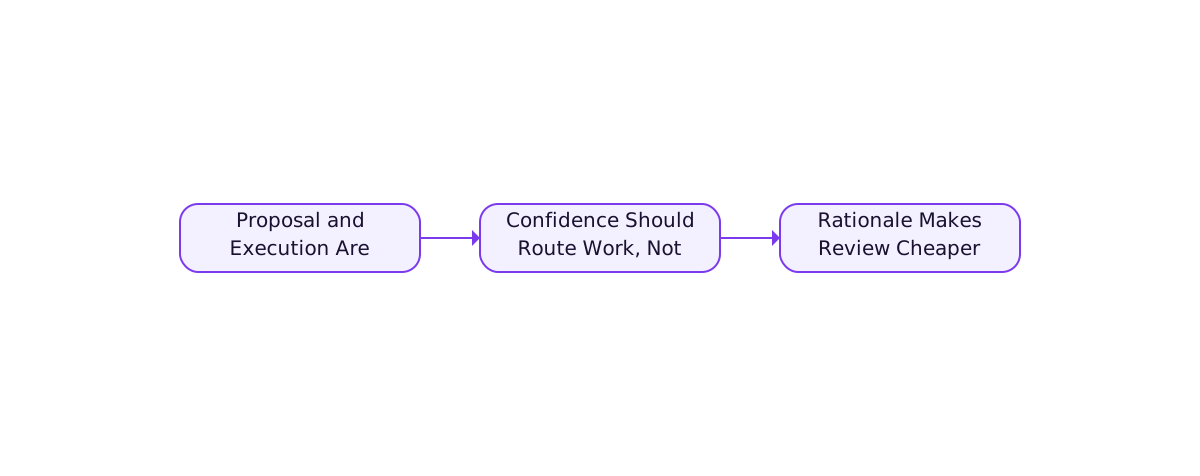
GitHub released agent automation controls for Issues in public preview on July 23, 2026. The release adds three related ideas to supported issue changes: approvals, confidence, and rationale. Automations can suggest a change instead of applying it; actions can be rated high, medium, or low confidence; and each supported action records why it was proposed.
The immediate use case is issue triage. The broader engineering pattern is more interesting: an agent should not collapse "I have a recommendation" and "the system changed" into one invisible step.
Proposal and Execution Are Different States
GitHub's preview can hold suggested changes in an issue panel for review. That creates a concrete intermediate state. A label change is no longer only absent or applied; it can be proposed, inspected, accepted, or declined.
This distinction helps when automation is useful but the cost of a wrong action varies. Adding a likely component label is easy to reverse. Closing a report as spam can hide legitimate work. Both may be "issue updates," but they deserve different policies.
Confidence Should Route Work, Not Prove Correctness
GitHub says supported actions can carry high, medium, or low confidence, with lower-confidence actions held for review depending on the configured threshold. That is a routing mechanism. It is not evidence that a high-confidence action is correct.
A robust workflow pairs confidence with deterministic constraints. An agent may be highly confident that an issue belongs to a component, while a schema can verify that the proposed label exists and a permission rule can verify that the agent is allowed to apply it. Confidence handles ambiguity; validators handle invariants.
Useful rule: Let confidence decide which review lane receives an action. Let permissions, schemas, tests, and policy decide whether the action is admissible.
Rationale Makes Review Cheaper
A rationale should identify the evidence that drove the action, not narrate vague internal reasoning. "Contains an iOS crash stack and names version 2.1" is reviewable. "This seems like the right label" is not. The first statement gives a maintainer something to verify quickly.
Rationale also improves later audits. If an automation repeatedly mislabels billing questions as account bugs, maintainers can inspect the recorded reasons and update the rule or prompt. Without rationale, the only signal is a pile of wrong metadata.
Approvals Are Not a Security Boundary
GitHub explicitly notes that these approvals are a workflow convenience, not a server-side security control. An agent with permission to change an issue may still apply changes directly. That caveat matters: a suggestion panel cannot replace least-privilege credentials, repository permissions, protected operations, or an external policy check.
The same principle applies to any agent product. A user-interface confirmation is useful for intent, but authorization must be enforced where the side effect occurs. If an operation is forbidden, the underlying token or API policy should make it impossible, not merely inconvenient.
A General Automation Contract
- Observe: collect the minimum evidence needed for the decision.
- Propose: name the exact action and target.
- Validate: check permissions, schema, and policy.
- Route: use risk and confidence to choose automatic execution or review.
- Execute: apply one bounded side effect.
- Record: persist the result, rationale, and evidence pointer.
- Recover: define how to reverse or correct the action.
This contract works for labels, assignments, content publication, dependency updates, and deployment preparation. The thresholds change, but the separation of states remains valuable.
What We Would Measure
Automation quality is not the number of actions applied. Measure accepted suggestions, corrected actions, time saved in review, reversals, and harmful misses. Break those outcomes down by confidence band. If "high confidence" actions are corrected often, the routing threshold or evidence model is wrong.
GitHub's release gives issue automation a clearer interaction model. Teams adopting it should preserve the caveat that GitHub itself states: review controls do not create a security boundary. The strongest implementation combines visible proposals with hard permissions and outcome-based evaluation.
References
- GitHub Changelog: Agent automation controls in GitHub Issues
- GitHub Docs: About Copilot automations
- GitHub Docs: About Copilot cloud agent
Agent features evolve quickly. Verify current availability, permissions, and limitations against official documentation before adopting a production workflow.