Claude Opus 5 and the Long-Running Agent Loop
On July 24, 2026, Anthropic announced Claude Opus 5, describing it as a step change for the Opus tier that powers long-running agents, with improvements in coding and professional work. The announcement focuses on sustaining agent workflows over extended sessions — the core capability an agent-driven software team needs.
A plan-build-review-verify loop is the shape of that work. An agent receives an intent, plans an approach, implements the change, submits to review, and runs verification before reporting completion. The loop can repeat within a session as review findings are addressed and verification re-runs. A model that sustains this loop without losing context or degrading in quality is what makes autonomous software production practical.
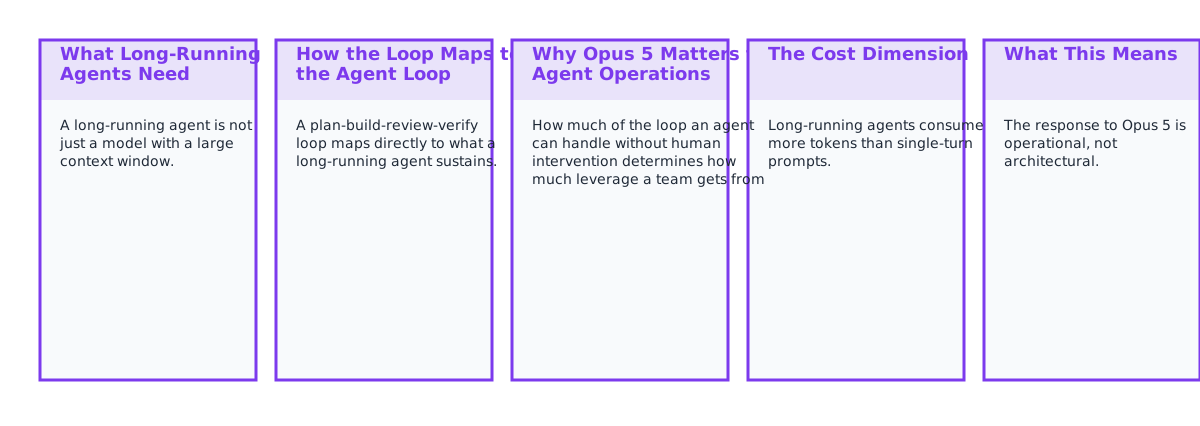
What Long-Running Agents Need
A long-running agent is not just a model with a large context window. It maintains coherent intent across many tool calls, retains earlier results, and makes consistent decisions as the session grows. The failure mode is context drift: the agent forgets why it started, repeats completed work, or contradicts an earlier decision.
Anthropic's announcement emphasizes long-running agents as a primary use case for Opus 5, implying the model was trained to maintain coherence over multi-step workflows, not just single-turn tasks. For agent-driven development, this matters because the unit of work is the session, not the prompt.
Principle: The unit of work is the session, not the prompt. A model that degrades over a 50-step session is less useful than one that stays coherent over 50 steps, even if the latter is slower per step.
How the Loop Maps to the Agent Loop
A plan-build-review-verify loop maps directly to what a long-running agent sustains. Plan: read the task, inspect the codebase, propose an approach. Build: make the changes. Review: an independent reviewer checks the diff. Verify: tests, lint, type checks, and validators confirm correctness.
Each phase is a checkpoint, not just a step. If review finds issues, the loop returns to build. If verification fails, the loop returns to build. The agent that sustains this loop handles the return trips without losing the thread — a model that works well on the first pass but degrades on revision cycles is less useful than one that stays coherent across cycles.
Why Opus 5 Matters for Agent Operations
How much of the loop an agent can handle without human intervention determines how much leverage a team gets from agent-driven work. A model that can plan, build, address review findings, and run verification autonomously increases that leverage; one that needs human help at each checkpoint keeps it low.
Opus 5's emphasis on long-running agents suggests it is designed to handle more of the loop autonomously. Review and verify remain checkpoints, but the agent's ability to address findings and re-run verification without losing context reduces the human intervention needed at each one.
The Cost Dimension
Long-running agents consume more tokens than single-turn prompts. A 50-step session with tool calls, file reads, and revisions can easily reach hundreds of thousands of tokens. The cost is higher, but so is the value if the session produces accepted, verified work.
Model selection should pick the cheapest tier that can safely satisfy the task. For long-running sessions touching architecture, security, or release workflows, a stronger model is justified. For repetitive, low-risk work, a cheaper model may suffice. Opus 5 adds a new option at the top of the tier ladder for the most demanding sessions.
What This Means
The response to Opus 5 is operational, not architectural. The loop does not change. The checkpoints do not change. What changes is the model's ability to sustain the loop, which affects how much the agent can handle autonomously and how much human intervention is needed at each checkpoint.
The next step is to evaluate Opus 5 on a representative session and measure agent hours vs human hours, review turnaround, and defect rate against the current model. If the evaluation shows meaningful improvement in sustained coherence, route long-running agent work to Opus 5 while keeping cheaper models for short, low-risk tasks.
Sources
Edoworks — a software factory.